
Facilities management companies rarely have a “cleaning chemicals problem” in isolation — they have a consistency problem. Different sites end up using different products, different dilution rates, and sometimes different suppliers altogether, often because purchasing decisions get made site-by-site rather than at a programme level. For an FM company managing facilities management cleaning supplies in Dubai across offices, retail units, residential towers and mixed-use developments, that inconsistency creates real operational risk: unpredictable results, harder staff training, and a documentation trail that’s difficult to defend if a client or auditor asks questions.
This guide looks at how a cleaning chemical programme should actually be structured for an FM operation — not a single product recommendation, but the framework an operations manager or procurement lead can use to evaluate whether their current supply setup is fit for purpose.
Why Site-by-Site Purchasing Creates Problems
When each site or subcontractor sources its own cleaning chemicals, a few predictable issues show up over time:
- Inconsistent results across sites. The same “general purpose cleaner” from different suppliers can vary significantly in concentration and performance, making it hard to set a uniform quality standard across a portfolio.
- Training complexity. Cleaning staff moving between sites have to relearn products, dilution ratios and safety handling each time, which increases the risk of misuse.
- Fragmented documentation. Safety Data Sheets (SDS) and Technical Information Sheets (TIS) end up scattered across multiple suppliers and formats, making it harder to produce a complete compliance file when a client, insurer or regulator requests one.
- Weaker negotiating position. Buying in small, disconnected quantities from multiple vendors usually costs more per unit than consolidating volume with fewer suppliers.
- Supply continuity risk. If a single site’s local supplier runs out of stock or discontinues a product, that site is exposed with no fallback — a risk that’s largely avoidable with a coordinated supply chain.
None of this means every FM company needs a single supplier for everything. But it does mean the chemical supply side of a cleaning programme deserves the same structured thinking that FM companies already apply to maintenance schedules, asset management and SLAs.
What a Structured Cleaning Chemical Programme Should Cover

A cleaning programme built for a multi-site FM operation typically needs to address six areas:
1. Product Range Coverage
A programme should map cleared, approved products against the range of environments an FM company actually services — offices, washrooms, common areas, external hardscapes, retail floors, and back-of-house areas. Typical categories include:
| Area | Chemical Category |
|---|---|
| General surfaces & floors | Neutral and heavy-duty floor cleaners, degreasers |
| Washrooms | Toilet cleaners, descalers, hand hygiene products |
| Glass & stainless steel | Glass and stainless steel cleaners |
| Carpets & soft furnishings | Carpet shampoo and spot/stain removers |
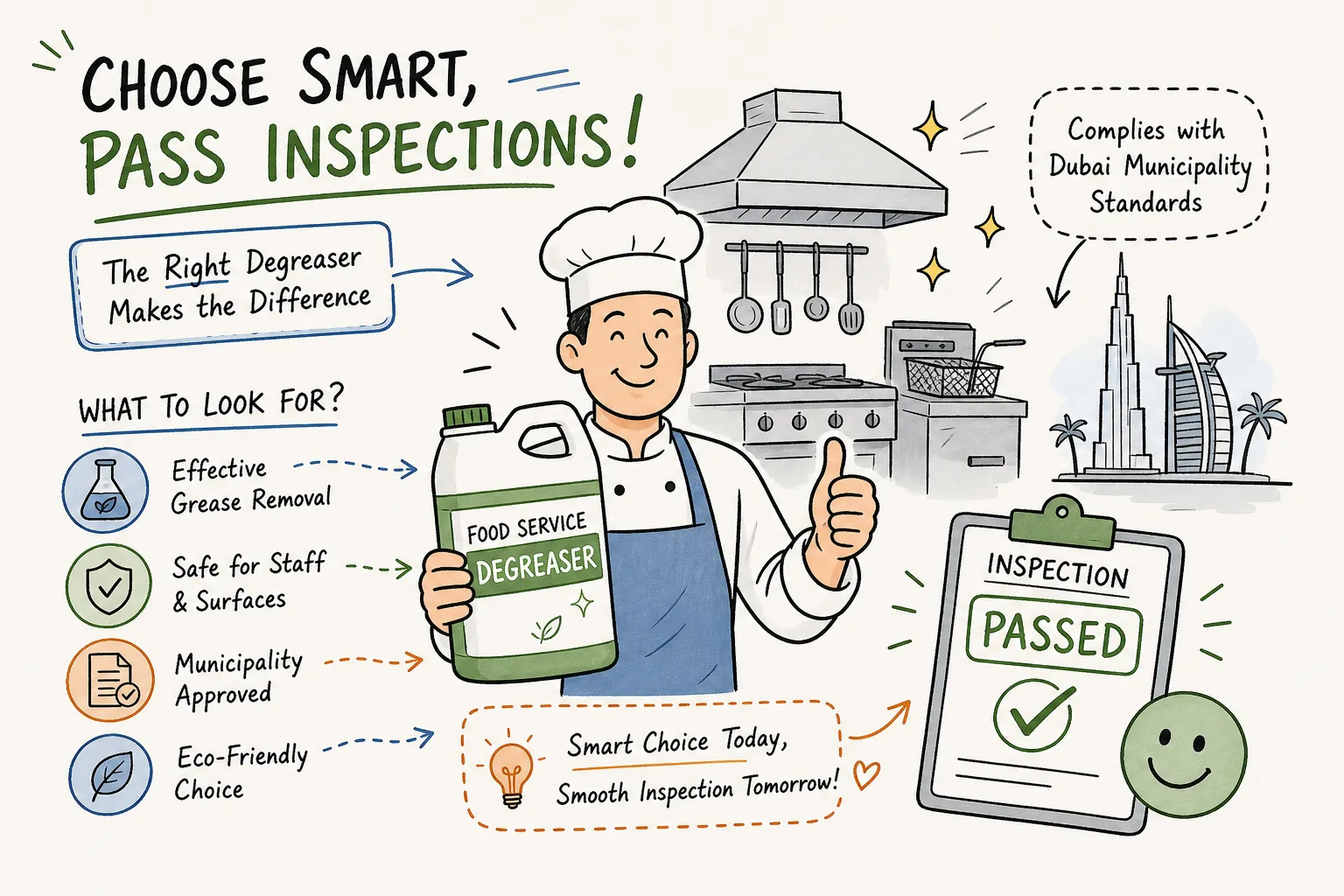
| Kitchens (if F&B tenants are in scope) | Kitchen degreasers, surface disinfectants |
| General disinfection | Multi-surface disinfectants for high-touch areas |
Mapping this out prevents the common failure mode where a site improvises with whatever’s available locally because the “correct” product was never formally specified for that area.
2. Dilution and Concentration Control
Concentrated chemicals are usually more cost-effective per use than ready-to-use products, but only if dilution is controlled properly on site. A programme should specify:
- The correct dilution ratio for each product and use case
- Dosing equipment (dilution control stations, measured pumps) where volume justifies it
- A simple reference method for cleaning staff — laminated dilution charts are still one of the most effective tools on the ground
Getting dilution wrong in either direction has a cost: too weak and cleaning performance suffers (with possible hygiene or client-satisfaction consequences); too strong and chemical spend rises unnecessarily while increasing the risk of surface damage or irritant exposure.
3. Staff Training and Safe Handling
Cleaning chemical incidents — skin irritation, accidental mixing of incompatible products, misuse of concentrates — are almost always a training gap rather than a product defect. A supply programme should be paired with:
- Basic safe-handling training when new products are introduced
- Clear labelling and colour-coding by area or chemical type
- Accessible SDS for every product in use, ideally centralised rather than held only at head office
4. Documentation and Compliance Records
FM contracts increasingly require documented proof of what’s being used, where, and why — particularly for clients in regulated sectors (healthcare, F&B, government). A well-run programme keeps:
- Up-to-date SDS and TIS for every active product
- A record of which products are approved for which site or client
- Change logs when a product is substituted or discontinued
This is also where consolidating suppliers pays off directly: chasing documentation from five different vendors across a dozen sites is a recurring administrative burden that a single, organised supply relationship removes.
5. Supply Consistency and Delivery Reliability
An FM company’s cleaning standards are only as reliable as its supply chain. Questions worth asking of any current or prospective supplier:
- Can they support delivery across all the sites in scope, not just a head office location?
- What happens if a specific product is temporarily unavailable — is there a suitable substitute already documented?
- Are lead times consistent enough to support scheduled replenishment rather than reactive ordering?
6. Cost Efficiency — Measured the Right Way
Price per litre is the wrong metric on its own. The more useful comparison is cost per use or cost per clean, which accounts for dilution ratio and product performance. A cheaper concentrate that dilutes at 1:100 can be significantly more economical over time than a more expensive ready-to-use product, even though the unit price looks higher on paper.
A Practical Supplier Evaluation Checklist
When comparing cleaning chemical suppliers for a multi-site FM contract, it’s worth scoring each against the same criteria used for any other critical supply relationship:
- Product range covers all site types and use cases in scope
- SDS and TIS documentation available and kept current
- Delivery capability across all relevant locations
- Consistent product formulation (no unadvised reformulation between orders)
- Dilution/dosing guidance provided, not just the product itself
- Responsive account support for reordering and issue resolution
- Transparent pricing that allows cost-per-use comparison, not just per-container pricing
Where This Fits Into a Wider FM Cleaning Strategy
Cleaning chemicals are one part of a broader hygiene and cleaning programme that also includes equipment, staffing levels, scheduling and quality inspection. Getting the chemical supply side right — consistent products, proper documentation, reliable delivery — removes one of the more common points of failure in FM cleaning contracts and makes the rest of the programme easier to manage and audit.
For FM companies reassessing their current setup, the starting point is usually a straightforward audit: what products are actually in use across sites right now, whether documentation exists for each of them, and whether the current supply arrangement can support the portfolio as it stands today — not just as it looked when the contract was first signed.
If you’re reviewing your cleaning chemical programme across multiple sites, Bio Dubai can walk through your current product range with you and identify where consolidation, documentation or supply reliability could be improved.
FAQ'S
How many cleaning chemical suppliers should an FM company use?
There’s no fixed number, but concentrating volume with fewer, more capable suppliers generally improves pricing, documentation consistency and supply reliability compared with sourcing separately at each site.
. What's the difference between cost per litre and cost per use?
Cost per litre only reflects the purchase price. Cost per use factors in the dilution ratio, so a concentrated product that costs more upfront can work out cheaper per clean than a diluted, lower-priced alternative.
. Do FM companies need SDS for every cleaning chemical in use?
Yes — Safety Data Sheets should be available for every chemical product in active use, both for staff safety and to satisfy client or regulatory documentation requests.
How often should a cleaning chemical programme be reviewed?
It’s good practice to review the product range and supplier arrangement at least annually, or whenever site portfolio, client requirements, or contract scope changes.
Can one cleaning chemical range cover offices, retail and residential sites?
Largely yes, since core categories (floor care, washroom hygiene, glass and surface cleaning, general disinfection) apply across most commercial environments — though F&B tenants or healthcare-adjacent sites may need additional specialist products.
What should be checked before switching cleaning chemical suppliers?
Confirm product equivalence for current use cases, dilution rates, documentation availability, delivery coverage across all sites, and a transition plan so cleaning teams aren’t retrained mid-contract without notice.
. Is it better to use concentrated chemicals or ready-to-use products for multi-site cleaning?
Concentrates generally offer better cost-per-use and reduce storage/transport volume, but they require proper dilution control on site — dosing equipment or clear dilution guidance is important to get the economics right.

Martin Danquah is the Growth & SEO Lead at Bio Dubai, where he leads the company’s SEO strategy, content development, local search optimisation, analytics, and marketing automation initiatives. Based in Dubai, he helps businesses across the UAE improve their online visibility, generate qualified leads, and achieve sustainable growth through technical SEO, Google Maps optimisation, AI-powered automation, and data-driven digital marketing strategies.
As the author of Bio Dubai’s SEO and educational content, Martin combines hands-on industry experience with practical search marketing expertise to help hospitality and food service businesses make informed decisions about hygiene, compliance, and operational best practices. He also provides independent SEO consulting through Dubai SEO Consultant, where he shares insights, case studies, and proven strategies for businesses looking to improve their organic search performance.