The right cleaning chemical supplier in Dubai affects more than your cleaning bill. It decides whether your kitchen, hotel or facility passes its next inspection, how much product your team wastes, and whether a stock-out ever stops your operation.
This guide explains the main types of cleaning chemicals used across the UAE, what to check before you choose a supplier, and answers to the questions buyers ask most.
Why the supplier matters as much as the product

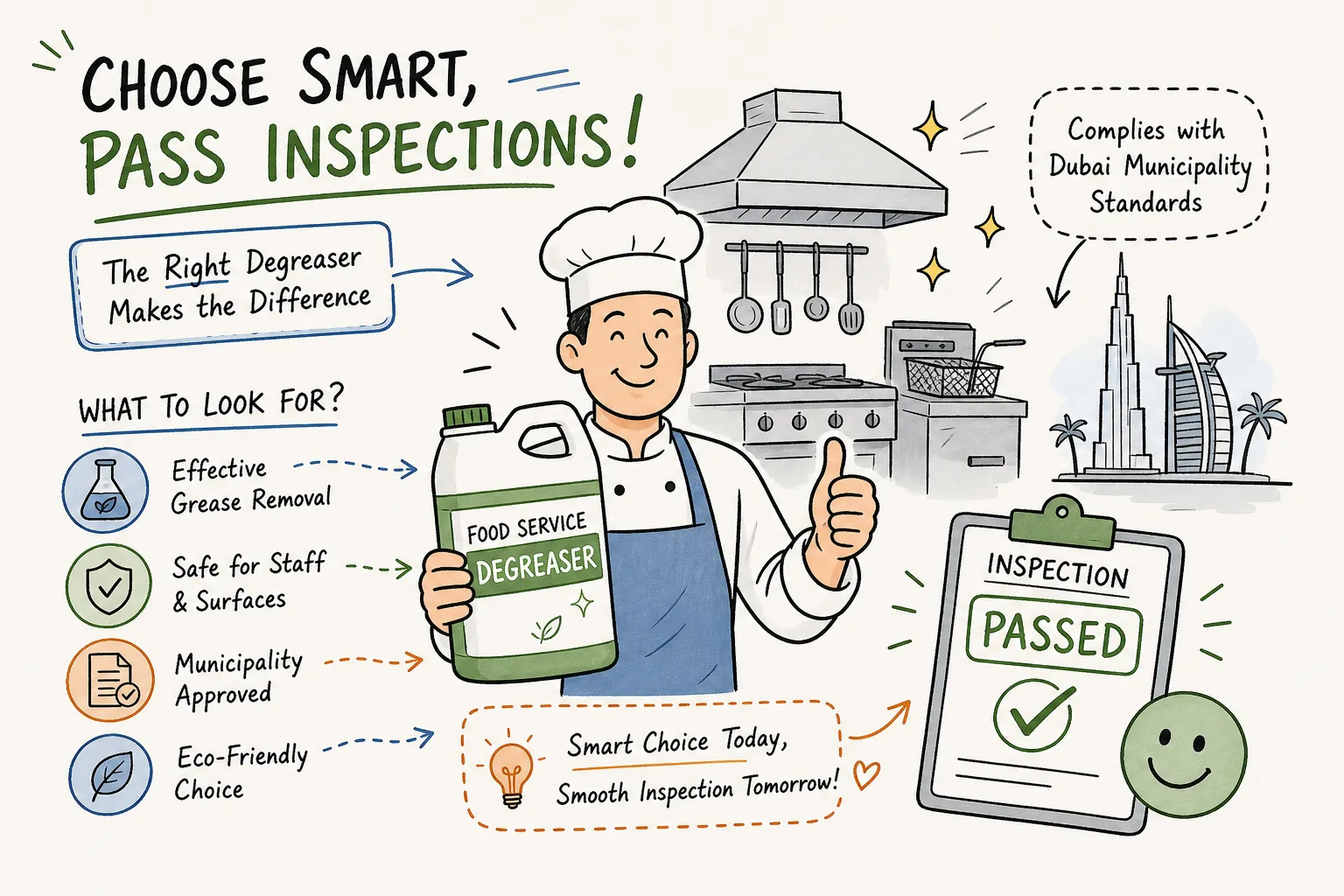
Generic cleaning agents often fall short in the UAE. Commercial-scale sanitation, hard water and strict municipal rules all demand products built for the job. A good supplier does more than deliver drums on time. They provide documentation for every product, work to Dubai Municipality (DM) requirements and HACCP food-safety frameworks, and help your team use the right product at the right dilution.
The four main categories of commercial cleaning chemicals
| Category | Typical products | Where it's used |
|---|---|---|
| Floor care | Neutral detergents, strippers, sealers, polishes | Hotels, malls, hospitals, warehouses |
| Housekeeping | Disinfectants, washroom cleaners, descalers, glass cleaners | Offices, hotels, residential buildings, healthcare |
| Kitchen products | Degreasers, dishwashing detergents, kitchen sanitisers | Restaurants, hotels, catering |
| Food grade | HACCP-compatible cleaners and sanitisers | Food production and food-contact areas |
You can browse the full range on our cleaning chemicals page.
Floor care chemicals
High-traffic floors need products matched to the surface. Neutral detergents handle daily mopping on tile and vinyl without damaging the finish. Alkaline strippers remove old wax and sealant before a floor is refinished, and acid-based cleaners deal with grout and mineral deposits. Using the wrong one is a common cause of dull, damaged floors.
Housekeeping and hygiene chemicals
These are the products used every day in offices, hotels and healthcare sites: multi-surface disinfectants, washroom cleaners and descalers, and glass cleaners. For disinfectants, check the dilution rate and contact time, since both drive cost and effectiveness. Cleaning removes visible soil, while disinfecting reduces microbial load on a surface that is already clean. Most facilities need both.
Kitchen degreasers and sanitisers
Commercial kitchens need heavy-duty degreasers for baked-on grease and carbon, plus sanitisers that are safe around food-contact surfaces. Confirm the product is suitable for food environments and that the rinsing instructions are clear.
Food-grade chemicals
Food manufacturers and kitchens working under HACCP need cleaners and sanitisers that are compatible with food-contact areas. Ask for the supporting certificates, not just a label claim.
What to check before you choose a supplier
Price matters, but these checks protect you from compliance problems and supply gaps.
- Dubai Municipality approval. Ask for proof that the products you will use are approved, especially disinfectants for food, healthcare and hospitality settings.
- Test certificates. For disinfectants, look for EN 1276 (bactericidal), EN 13704 (fungicidal) and EN 14476 (virucidal) results rather than general claims.
- Documentation with every order. You should receive an MSDS and a technical data sheet (TDS) for each product. You will need them for audits and staff training.
- Stock and delivery. Check pack sizes, stock availability and delivery times to your location. A stock-out on a daily-use product disrupts operations quickly.
- Training and support. A supplier who shows your team the right dilution and application saves product and prevents surface damage. Ask whether on-site training is included.
- Quality and environmental systems. ISO 9001, ISO 14001 and ISO 45001 certification, REACH compliance and GHS-compliant labelling show a supplier takes quality and safety seriously.
If you are preparing for an inspection, read our guide on how to pass a Dubai Municipality hygiene audit, or book a hygiene audit to check your current setup before you switch suppliers.
Frequently asked questions
Which chemical is used for floor cleaning?
It depends on the floor material and how much traffic it gets. Neutral detergents suit daily mopping on tile and vinyl. High-alkaline strippers remove old wax and sealant before refinishing, and acid-based cleaners are used for grout restoration and mineral deposits. Always check the manufacturer’s guidance for the surface, since the wrong chemical can etch or dull it.
Do AC cleaning companies in Dubai use chemicals?
Yes. AC and HVAC maintenance companies use specialist coil cleaners, typically alkaline or acidic foaming agents. These break down grease, dust, mould and biological build-up on evaporator and condenser coils, which improves cooling efficiency and indoor air quality. The coils are rinsed after treatment.
How do you clean up a chemical spill in the workplace?
Follow the product’s MSDS first, then work through these steps:
- Alert people nearby and evacuate the area if needed.
- Put on the right PPE, such as gloves, goggles and a respirator where the MSDS requires one.
- Contain the spill with absorbent pads or a spill kit, using a neutraliser where the MSDS recommends it.
- Collect the waste and dispose of it according to UAE and municipal waste regulations.
- Report the incident and restock the spill kit.
How can businesses buy cleaning chemicals in bulk in the UAE?
Work with a supplier that holds stock locally and can quote by volume. Share your product list, monthly usage and delivery locations, and ask for MSDS and TDS documents, pack sizes and delivery times before you commit.
How should commercial cleaning chemicals be stored?
Store them in their original labelled containers, in a cool, dry, ventilated area away from direct sunlight. Keep incompatible products apart, in particular acids from chlorine-based products and alkalis from acids. Keep MSDS sheets accessible and train staff in handling and emergency procedures.
Talk to Bio Dubai
Bio Dubai supplies Dubai Municipality approved, UK-manufactured cleaning chemicals and disinfectants to hotels, restaurants and facilities across the UAE, with full MSDS and TDS documentation on every order.
- Request a quote on WhatsApp
- Book a free hygiene audit call

Martin Danquah is the Growth & SEO Lead at Bio Dubai, where he leads the company’s SEO strategy, content development, local search optimisation, analytics, and marketing automation initiatives. Based in Dubai, he helps businesses across the UAE improve their online visibility, generate qualified leads, and achieve sustainable growth through technical SEO, Google Maps optimisation, AI-powered automation, and data-driven digital marketing strategies.
As the author of Bio Dubai’s SEO and educational content, Martin combines hands-on industry experience with practical search marketing expertise to help hospitality and food service businesses make informed decisions about hygiene, compliance, and operational best practices. He also provides independent SEO consulting through Dubai SEO Consultant, where he shares insights, case studies, and proven strategies for businesses looking to improve their organic search performance.