
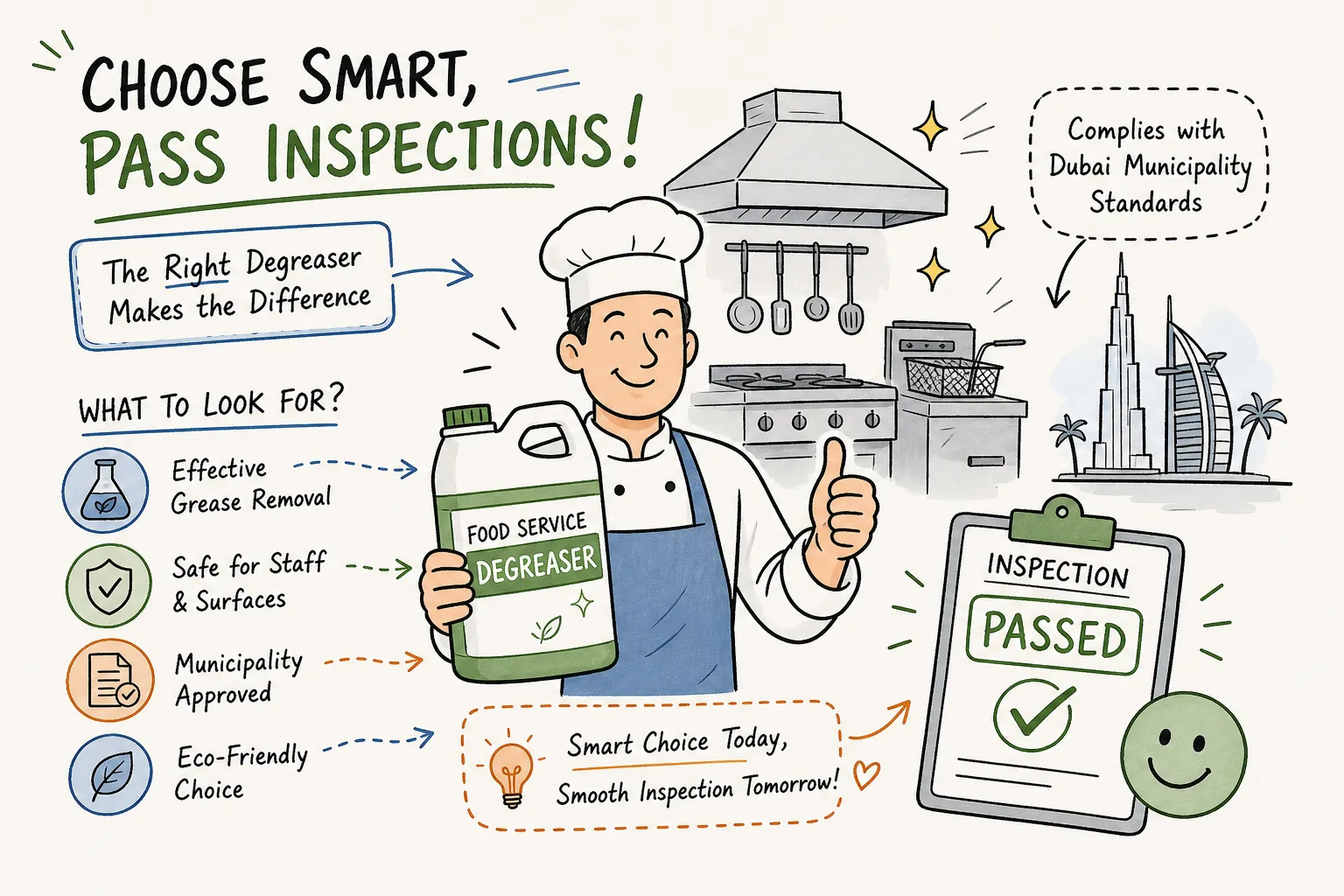
A common reason Dubai food establishments get flagged during Municipality inspections is not a dirty kitchen. It is the wrong food service degreaser, or an inability to produce the paperwork proving the one in use is approved. Grease buildup is a real food safety and fire hazard, and the product used to remove it has to meet specific chemical and regulatory criteria in this market. A commercial kitchen degreaser that is popular in the U.S. or Europe does not automatically qualify here, and finding that out during an inspection is an expensive lesson.
This guide covers formulation types, NSF categories, Dubai Municipality documentation, dilution and PPE, cost-per-use maths, and a real hotel example. By the end you will know what to look for on a datasheet, what your inspector expects to see, and how to work out whether a concentrate really saves money over ready-to-use.
If you want the product-focused overview first, start with our food service degreaser guide for UAE kitchens. This article goes deeper on the inspection side.
Why grease control is a food safety and fire risk, not just a hygiene preference
The real risks of grease accumulation in commercial kitchens
Grease on hood filters, ductwork and fryer surfaces is a documented fire hazard. Lipid-rich deposits ignite quickly and spread through ductwork, turning a contained equipment fire into a structural one. Baked-on grease that flakes from oven walls or equipment housings can also contaminate food directly. Warm, nutrient-rich residue in floor channels, drains and behind equipment gives bacteria ideal conditions to grow.
The consequence is not only a failed inspection. It is a contamination pathway that sits in your kitchen every service. Choosing a food-grade degreaser that removes lipid deposits at the soil levels your kitchen actually produces is the starting point.
What Dubai Municipality inspectors actually look for
A visual pass is not the same as a documentation pass. Inspectors assess surface hygiene, but they also ask for proof that your chemicals are approved and suitable for food establishments. Common citation triggers include:
- Missing Safety Data Sheets (SDS)
- Chemicals that are not on the approved list
- Unlabelled secondary containers
- Cleaning schedules that do not reference approved products
If you cannot show an approval certificate, a current SDS and a documented cleaning procedure for each chemical, a clean-looking surface will not save you. For the wider picture, see our guide to passing Dubai Municipality hygiene audits.
Choosing a food service degreaser for Dubai kitchens: formulation types
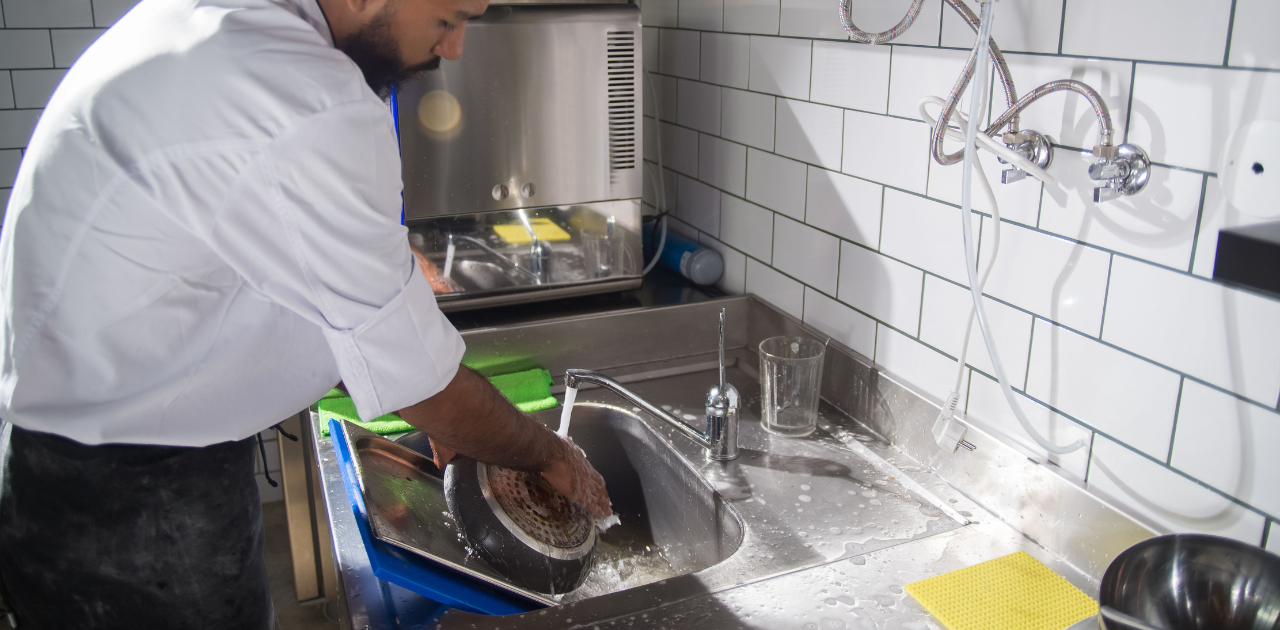
Alkaline degreasers: the workhorse for most commercial kitchens
Alkaline chemistry, typically sodium or potassium hydroxide with builders and surfactants, breaks down fats, oils and proteins through saponification and emulsification. That makes it the standard choice for hoods, ovens, fryers and floor grease. Most products run at a pH above 10, with stronger concentrations at the upper end.
One compatibility note: high-alkaline products can attack aluminium, painted surfaces and soft metals, so test on your equipment before using at full strength.
Typical Bio Dubai options in this family include our Liquid Degreaser 5O, Degreaser Concentrate 5XD, Cleaner Degreaser Concentrate SA51 and Powder Degreaser 5B. For baked-on carbon, look at the De-Carbonizing Powder 7C and Oven Spray 7B. Combi ovens have their own chemistry: see the Combi Oven Cleaner 7K and our oven cleaning service page.
Foaming formats are a useful subset. Foam clings to vertical surfaces such as hood systems, extending dwell time without runoff. For routine hood cleaning, a foaming alkaline product such as our Alkaline Foam Cleaner F01 is often more effective per application than a spray of equivalent chemistry.
Enzyme-based and solvent-based options: niche use cases
Enzyme products suit drain maintenance and light organic soil, where slow biological breakdown is the goal. They are not the right tool for heavy baked-on grease. For drains and grease traps, see our Enzyme Drain Grease 9B.
Solvent-based products (glycol ethers, citrus terpenes, hydrocarbon solvents) suit mechanical or industrial jobs outside the food prep zone. They carry higher VOC and flammability concerns and are not typically appropriate for food-contact surfaces in a restaurant kitchen.
When a degreaser should be foaming, concentrate or ready-to-use
The same alkaline chemistry ships as concentrate, ready-to-use (RTU) spray and foam. RTU is faster for spot cleaning. Concentrates make more sense for floors, hoods and large-area work. Format also affects compliance: an under-diluted concentrate can leave hazardous residue on food-contact surfaces, while an over-diluted one will not remove grease. That is why the dilution chart on your datasheet is a compliance document, not a suggestion.
NSF certification and Dubai Municipality approval: what each means
NSF categories: A1 and A8
NSF nonfood compound registration tells you the approved use category of a product. It does not mean the product is safe to leave on food-contact surfaces.
- A1 covers general cleaners used in and around food-processing areas where direct food contact is not intended.
- A8 is the category most relevant to a food service degreaser. It covers degreasers and carbon removers for cooking and smoking equipment, utensils and associated surfaces, where use is not intended for direct food contact.
In both cases, food and packaging must be removed before use, and a potable-water rinse is required after the dwell period unless the label explicitly says otherwise.
Always verify the exact product name, registration number and category code in the current NSF White Book, not on a retailer label or distributor summary. A registration is only current when the registered product name appears in the White Book with the matching category code.
Dubai Municipality chemical approval for food establishments

Dubai Municipality’s food safety framework expects cleaning chemicals in licensed food establishments to be approved. The documentation inspectors typically want includes:
- A Dubai Municipality or Food Control Department approval certificate
- A current SDS with the relevant sections intact
- A technical datasheet showing dilution ratios and food-contact instructions
- A documented cleaning schedule that names the approved products
A product with global NSF registration still needs UAE-specific documentation to satisfy a local inspector. These are two separate frameworks, and passing one does not satisfy the other. Our page on Dubai Municipality approved disinfectants and chemicals and our guide to approved cleaning chemicals for UAE businesses explain how to check this for any product.
This is where Bio Detergents & Disinfectants Trading L.L.C. (Bio Dubai) removes a significant burden. Our products come with the documentation set, including approval certificates, SDS and technical datasheets, so your procurement team does not have to chase paperwork across suppliers.
The documentation checklist inspectors want to see
For each chemical in your kitchen, your inspection file should contain:
- The Dubai Municipality chemical approval certificate
- A current SDS with Sections 2, 3, 8 and 9 complete
- A technical datasheet with dilution ratios and food-contact instructions
- A written cleaning programme listing each approved product, application schedule and responsible staff
Many facilities underestimate the paperwork. Having it ready before the inspector arrives is what separates a clean audit from a costly citation.
Safe dilution, application and PPE
Dilution and dwell time by soil level
These are typical ranges. The product label and technical datasheet always override them.
| Soil level | Typical dilution | Application | Dwell time |
|---|---|---|---|
| Light maintenance | 1:50 to 1:256 | Mop or spray | 30 seconds to 5 minutes |
| Medium grease | 1:16 to 1:50 | Spray or foam | 3 to 7 minutes |
| Heavy grease | 1:4 to 1:16 | Foam or heavy spray | 5 to 15 minutes |
| Baked-on deposits | 1:1 to 1:5 | Near-undiluted, with agitation | 15 to 30 minutes |
Improper dilution is both a safety issue and a compliance issue, and one of the most common avoidable mistakes in kitchen chemical management. Accurate dosing equipment removes the guesswork: see our dispenser and dosing systems, and use pH test strips to spot-check working solutions.
Application methods: spray, foam, mop
- Spray suits spot cleaning and vertical equipment surfaces.
- Foam suits hood systems and large greasy vertical areas.
- Mop or auto-scrubber suits floors and broad horizontal surfaces.
As a planning figure, light spray or mop cleaning covers roughly 10 to 25 m² per litre of ready-to-use solution. Heavy deposits cover far less, because you need enough contact to penetrate and lift the buildup.
PPE and rinsing requirements
Minimum PPE for alkaline degreasers is chemical-resistant gloves, splash goggles, a protective apron and good ventilation. For concentrates and caustic-grade products, add a face shield, full arm protection, local exhaust ventilation and an accessible eyewash station. Our safety kit and cleaning gloves cover the basics.
The rinsing rule for food-contact surfaces is firm: remove food and packaging, apply at the correct dilution, observe the dwell time, agitate if needed, and rinse thoroughly with potable water. Skip the rinse only if the label explicitly authorises no-rinse use, and confirm that against the NSF registration, not a marketing claim. For surfaces that need sanitising after degreasing, see our food contact surface sanitisers guide.
Never mix chemicals. Chlorine bleach with an acid releases chlorine gas. Bleach with ammonia releases toxic chloramine vapour. An acid with a caustic generates heat and creates a splash hazard.
PPE and rinsing requirements for food-contact surfaces
Minimum PPE for alkaline degreasers includes chemical-resistant nitrile gloves, splash goggles, a
protective apron, and adequate ventilation. For concentrates and caustic-grade products, elevate to a face
shield, full arm protection, local exhaust ventilation, and an accessible eyewash station. The rinsing rule
for food-contact surfaces is non-negotiable: remove food and packaging, apply the product at the correct
dilution, allow the stated dwell time, agitate if needed, and rinse thoroughly with potable water. Never skip
this step unless the label explicitly authorizes no-rinse use, and confirm that authorization against the
NSF registration, not a marketing claim.
One additional warning worth drilling into your team: never mix degreasers with bleach, acids, or
ammonia. Combining an acid with a hypochlorite releases chlorine gas. Combining an acid with a caustic
generates heat and creates a splash hazard.
Concentrate vs. ready-to-use: the real cost-per-use numbers
The formula is simple:
Cost per finished litre = concentrate price per litre ÷ (dilution parts + 1)
Here is an illustrative comparison for a busy kitchen using 400 litres of working solution per week. The prices are examples to show the method, not a quote.
| RTU product | Concentrate at 1:32 | |
|---|---|---|
| Price | AED 4.00 per litre | AED 25.00 per litre of concentrate |
| Cost per finished litre | AED 4.00 | AED 25 ÷ 33 = about AED 0.76 |
| Weekly cost (400 L) | AED 1,600 | about AED 303 |
| Annual cost | AED 83,200 | about AED 15,800 |
In this example the concentrate saves roughly AED 67,000 a year, before counting freight and storage of the water weight in RTU products. For regular commercial kitchen use, a concentrate is usually the better economic choice. RTU still earns its place for quick spot cleaning. The trade-off is that concentrates need accurate measuring equipment and consistent staff training, both manageable with the right supplier support.
What to ask your supplier before you buy
A capable supplier should provide:
- A current SDS
- The NSF certificate with registration number and category code
- A dilution chart matched to your soil and surface types
- A surface compatibility statement for your equipment
- Full Dubai Municipality approval documentation
Most local distributors supply some of this. Few supply all of it, and the gap between “some” and “all” is your inspection exposure. If a supplier cannot provide the full set upfront, that is your answer. Our guide to choosing a cleaning chemical supplier in Dubai gives a fuller vendor checklist.
Case study: how a Dubai hotel passed its inspection with a tailored degreaser programme
Client details anonymised.
The challenge: wrong products, missing paperwork, upcoming inspection
A mid-size Dubai hotel with multiple F&B outlets was using a mix of imported cleaners across its kitchens. A pre-inspection internal audit found that three of its five kitchen chemicals had no SDS on site, and two products were not on the Dubai Municipality approved list. The products were not necessarily ineffective at removing grease. They simply could not be verified as approved, and the paperwork did not exist.
The solution: approved products plus full documentation
We assessed the property’s kitchen zones, soil types and surface materials, then recommended approved, food-grade alkaline products matched to each zone:
- A foaming degreaser for hood systems
- A concentrated alkaline formula for cooking equipment and fryer surfaces
- A floor-specific cleaner for channels and drains
- A lower-alkalinity food-safe formula for food preparation surfaces
Every product came with its approval certificate, SDS and technical datasheet, plus a written cleaning programme with dilution charts and application schedules. The hotel passed its inspection with no chemical-related citations. The difference was the right chemistry and the right paperwork, delivered together.
For hotel-specific guidance, read our procurement manager’s guide to hygiene chemicals for hotels and see how we support hotels and lodgings and restaurants and bars.
Your degreaser decision: four criteria that must work together
-
- Match the formulation to your soil type and surfaces.
- Confirm the NSF category and Dubai Municipality approval for each product.
- Train your team on dilution ratios and PPE.
- Keep the documentation package ready before an inspector arrives.
A correctly formulated product without documentation fails the audit. A well-documented product used at the wrong dilution creates a safety and compliance risk. The framework only works when all four are in place.
FAQs
Does an NSF-registered degreaser automatically pass a Dubai Municipality inspection?
No. NSF registration and Dubai Municipality approval are separate frameworks. You need UAE-specific approval documentation as well.
Which NSF category applies to a kitchen degreaser?
A8 covers degreasers and carbon removers for cooking and smoking equipment. Verify the exact category in the NSF White Book.
Do I need to rinse after using a food service degreaser?
Yes, with potable water, on food-contact surfaces, unless the label explicitly authorises no-rinse use.
Is a concentrate cheaper than ready-to-use?
For regular, high-volume cleaning, usually yes. Divide the concentrate price per litre by the dilution parts plus one to get the true cost per finished litre.
What documents should be in my kitchen’s chemical file?
An approval certificate, a current SDS, a technical datasheet with dilution and food-contact instructions, and a written cleaning programme that names each product. Browse our kitchen products and food grade range to see the documentation we supply.
Get a compliance-ready degreaser programme
Talk to the Bio Dubai team about a Dubai Municipality approved degreaser with full documentation, matched to your facility type, kitchen zones and inspection requirements. Book a free hygiene audit, explore our support programmes, or contact us on +971 55 834 7631.

Martin Danquah is the Growth & SEO Lead at Bio Dubai, where he leads the company’s SEO strategy, content development, local search optimisation, analytics, and marketing automation initiatives. Based in Dubai, he helps businesses across the UAE improve their online visibility, generate qualified leads, and achieve sustainable growth through technical SEO, Google Maps optimisation, AI-powered automation, and data-driven digital marketing strategies.
As the author of Bio Dubai’s SEO and educational content, Martin combines hands-on industry experience with practical search marketing expertise to help hospitality and food service businesses make informed decisions about hygiene, compliance, and operational best practices. He also provides independent SEO consulting through Dubai SEO Consultant, where he shares insights, case studies, and proven strategies for businesses looking to improve their organic search performance.